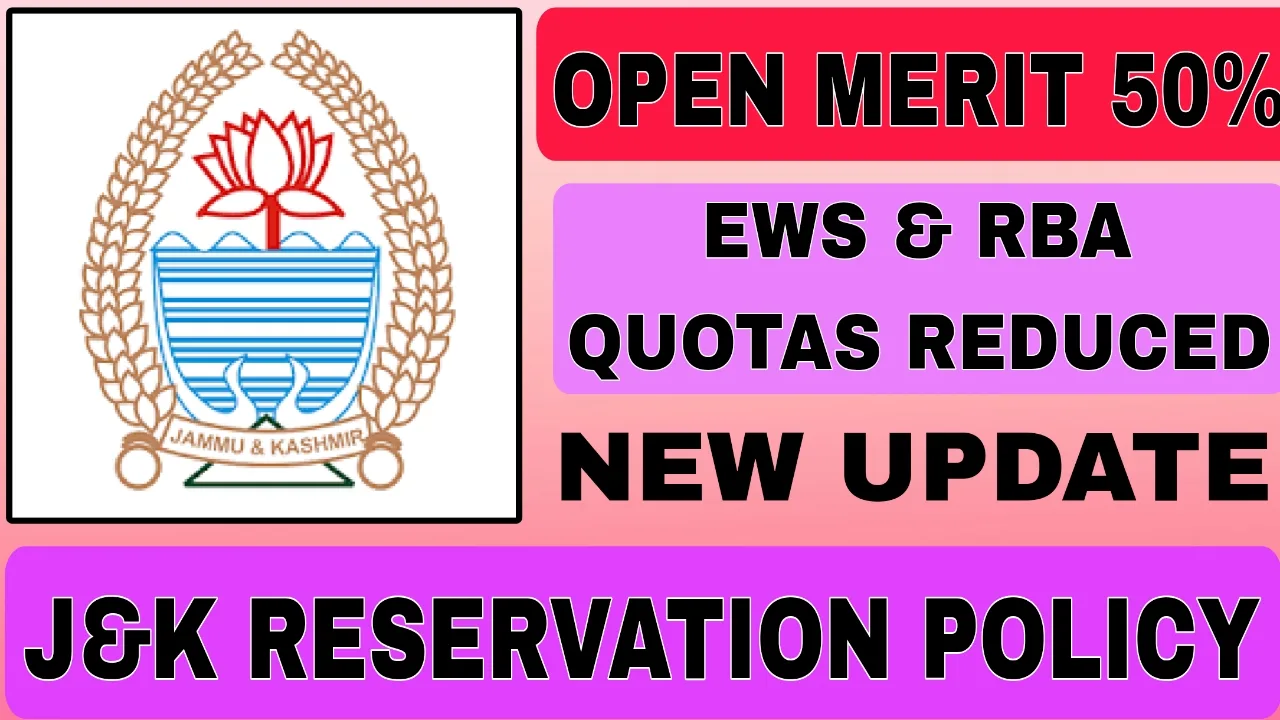
The Jammu & Kashmir government has initiated a major restructuring of its reservation framework that is triggering widespread discussions across political, social and administrative circles for benefit of open merit candidate. In a significant move taken by the J&K cabinet has endorsed a proposal to reduce the quota percentages for the Economically Weaker Sections (EWS) and the Reserved Backward Area (RBA) categories. This revision is intended to boost the Open Merit (OM) category’s share by 10 percent a decision that marks one of the most impactful policy shifts in recent years. The cabinet’s decision aligns entirely with the recommendations of the Cabinet Sub-Committee – CSC which earlier examined the existing reservation matrix and advised that certain categories which is including Scheduled Tribe-I, Scheduled Tribe-II, Scheduled Castes, Other Backward Classes, and Actual Line of Control/International Border (ALC/IB)—should remain untouched. This selective revision indicates a calibrated approach aimed at preserving the rights of historically marginalized groups while broadening opportunities under the Open Merit category.
Current Reservation Structure in J&K
Before this proposed revision, the reservation percentages in Jammu & Kashmir were distributed as follows:
| Category | Reservation (%) |
|---|---|
| ST-I | 10% |
| ST-II | 10% |
| RBA | 10% |
| EWS | 10% |
| Scheduled Castes (SC) | 8% |
| Other Backward Classes (OBC) | 8% |
| ALC/IB | 4% |
If approved, the EWS and RBA cuts will reduce quotas in these categories, while Open Merit will expand proportionately by 10%.
Why the Proposal Requires LG and Centre Consultation
While the cabinet has endorsed the move, the Lieutenant Governor must review and approve it before it becomes official. Under the Transaction of Business of the Government of Union Territory of Jammu and Kashmir Rules, 2019, any decision that could impact minority communities, Scheduled Castes, Scheduled Tribes, or Backward Classes must be referred to the Central Government, specifically the Ministry of Home Affairs. This procedural requirement ensures that reservation policies align with national frameworks and safeguard the constitutional rights of all groups. As the proposed quota cuts affect RBA and EWS—both classified under backward classes—the Lieutenant Governor is expected to make a formal reference to the Union Government before granting approval.
Why the Cabinet Opted for Changes in EWS and RBA
The Cabinet Sub-Committee recommended that only EWS and RBA quotas be modified while keeping other reserved categories intact. The rationale appears to be rooted in maintaining balance:
- ST, SC, OBC, and ALC/IB communities have historically been underrepresented and continue to rely on affirmative policies for educational and employment access.
- EWS and RBA, while important, were deemed relatively more flexible in terms of adjustment without violating constitutional protections.
This assessment led to the recommendation of a 7% cut in EWS and a 3% reduction in RBA, together contributing to a substantial rise in Open Merit opportunities.
Implications of Raising Open Merit to 50%
If implemented, the Open Merit category—a non-reserved classification—will expand to half of the total vertical reservation space. This change could lead to several outcomes:
Potential Benefits
- More opportunities for general-category candidates, especially in regions where competition has intensified.
- Balanced representation in recruitment and admissions, ensuring merit receives greater consideration.
- Better alignment with national reservation trends, where 50% is often cited as the ceiling for affirmative quotas.
Possible Challenges
- Concerns among EWS and RBA groups regarding reduced access to educational and job opportunities.
- Political disagreements, as seen in initial responses from opposition parties and other political stakeholders.
Key Takeaways at a Glance
| Aspect | Details |
|---|---|
| EWS reduction | 7% |
| RBA reduction | 3% |
| Increase in Open Merit | 10% |
| OM share after approval | 50% |
| Categories unchanged | ST-I, ST-II, SC, OBC, ALC/IB |
| Next step | Lieutenant Governor’s approval & central consultation |